Best Time to Visit the Amalfi Coast
The best time to visit the Amalfi Coast — why spring and autumn beat the July–August heat and traffic, what each season is like, and the best window for a day trip from Rome.
The Amalfi Coast is beautiful year-round, but when you go changes the experience more than almost anything else — especially on a day trip, where every hour of coast-road traffic eats into your limited time on the ground. This guide breaks the year down so you can pick your window. For getting there in the first place, see how to get from Rome to the Amalfi Coast.
The Short Answer
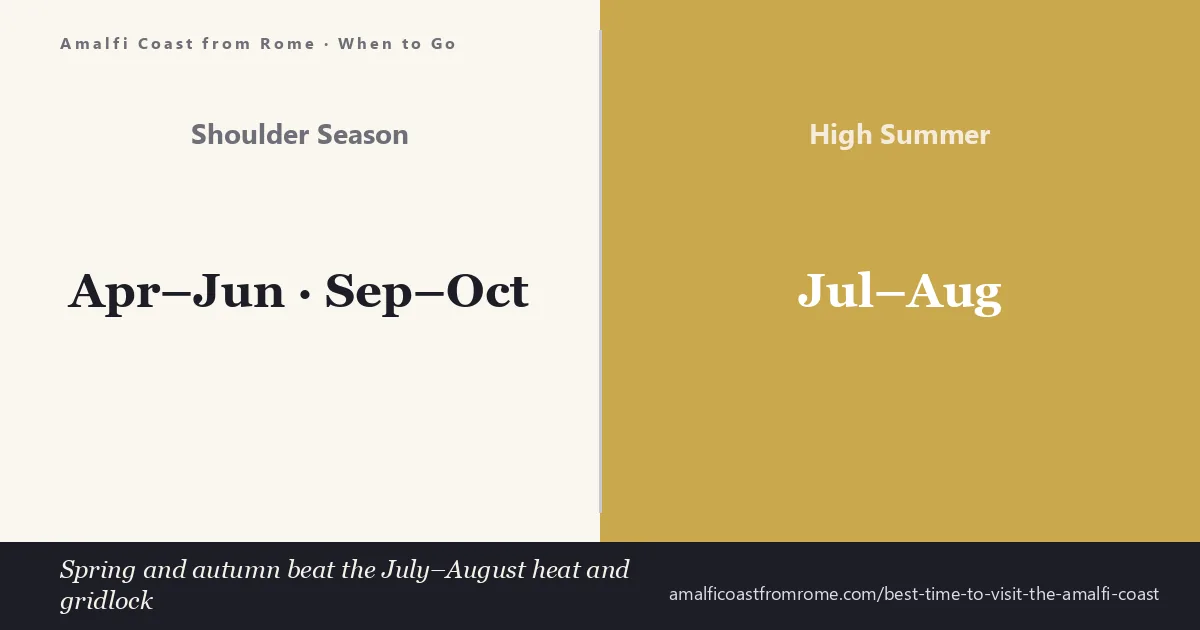
For the best mix of warm weather, manageable crowds and a coast road that actually moves, aim for the shoulder seasons — roughly April to June and September to October. May and September are the sweet spot. July and August are the hottest, busiest and most traffic-clogged months, and winter is quiet and mild but pared back.
Season by Season
| Season | What to expect |
|---|---|
| Spring (Apr–Jun) | Mild, green, wildflowers; early June still calm — a top pick |
| Summer (Jul–Aug) | Hot (30°C+), crowded, heavy SS163 traffic — go early or off-peak |
| Autumn (Sep–Oct) | Warm sea, softening heat, thinning crowds — the other top pick |
| Winter (Nov–Mar) | Quiet and coastal-mild, but many hotels, restaurants and ferries close |
Spring and autumn are the clear winners. April warms from cool sunny days into the high teens and low twenties Celsius, with wildflowers in the hills; May is reliably lovely. After the summer peak, September keeps a warm sea with easing crowds, and October is ideal for the coast’s walking trails.
Why High Summer Is the One to Plan Around
July and August are the warmest and by far the busiest months — August routinely tops 30°C (86°F), and more than half a million visitors pour onto the coast that month. The narrow SS163 coast road becomes the bottleneck: bumper-to-bumper traffic turns short distances into long ones, and authorities impose summer restrictions on non-resident cars along stretches between Vietri sul Mare and Positano to manage the crush. On a day trip from Rome, that traffic directly shortens your time in Positano or Amalfi. If summer is your only window, accept the early start and lean on a guided trip to absorb the road. (See why the day is long in is the Amalfi Coast worth it as a day trip.)
A Note on Easter and Shoulder Edges
The shoulder seasons aren’t uniformly quiet. Easter week is a popular period that brings its own traffic and even temporary SS163 restrictions, so check the calendar if you’re travelling around then. And the very edges of winter — late March, early November — can be glorious or rainy; they’re a gamble that often pays off in solitude.
Winter: Quiet, Mild, but Pared Back
From November to March the coast is at its calmest and the weather stays coastal-mild, but it comes with a catch: many smaller-town hotels and restaurants close, and a lot of the ferries and hydrofoils don’t run. For a day trip built around Pompeii plus a coastal town, winter is still very doable — just expect a quieter, sleepier coast and fewer on-water options.
Best Window for a Day Trip from Rome
If you’re coming down from Rome for the day, target late April through June or September into October: comfortable temperatures, a coast road that flows, and long enough daylight to fit Pompeii and a town before the drive home. Avoid the July–August midweek peak if you can, and always take the early departure. For the trade-off against staying over, see day trip vs overnight.
Ready to Book?
A top-rated Rome to Amalfi Coast day trip runs through the seasons, pairing skip-the-line Pompeii with free time in Positano, Amalfi and Sorrento — free cancellation up to 24 hours before. Check availability and pick your window.
See the Amalfi Coast the Easy Way
Let an organized day trip handle the long drive, the coast road, and the logistics — Pompeii, Positano, Amalfi and Sorrento in one day from Rome. Free cancellation up to 24 hours before.
Check Availability & Book